
Every now and then, a discovery comes along that not only changes what we know about the past but also reveals the enchanting layers of mystery in our world. This is a tale of how one diligent student uncovered a forgotten link between two fossils, leading to the rebirth of an ancient species. Join us on this journey of reconnecting history, discovery, and a remarkable twist of fate.
Meet Victor Beccari, an enthusiastic Ph.D. student with an extraordinary knack for details. During a visit to the London Natural History Museum, he found himself captivated by a slab of rock showcasing an impression of a Jurassic-period reptile. Something about it felt eerily familiar, sparking a sense of curiosity within him that he could not ignore.
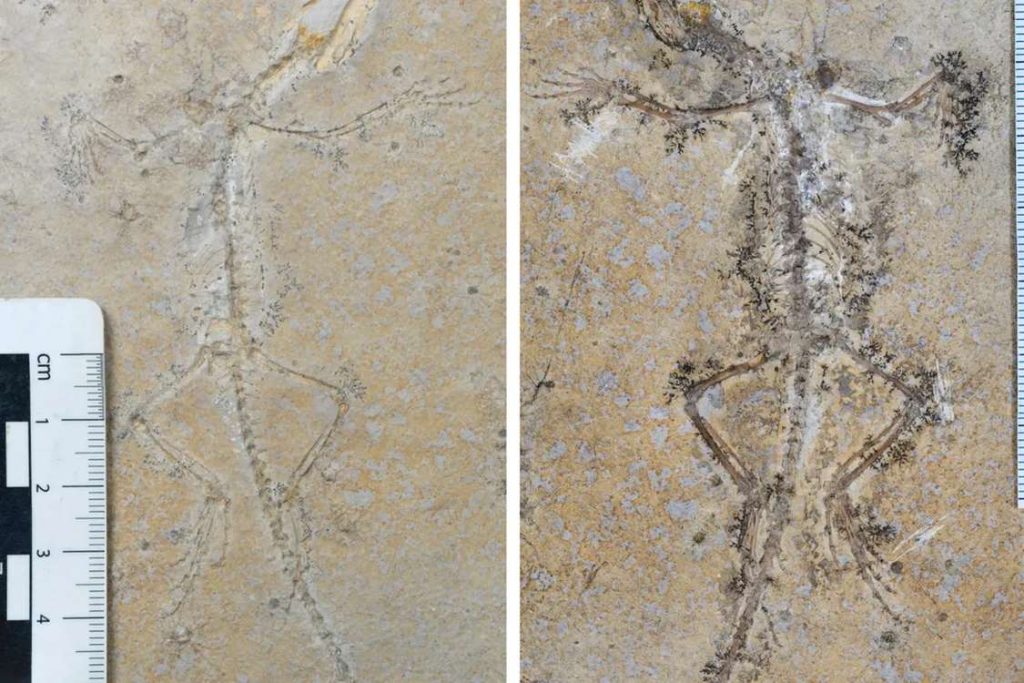
As he roamed the halls, a flash of memory hit him like a bolt of lightning. He recalled a similar fossil he had seen at the Senckenberg Natural History Museum in Frankfurt—two halves of what seemed to be the same fossil, separated by time and circumstance.
Victor’s instinct urged him to investigate further. Armed with determination and enthusiasm, he embarked on a quest to confirm his suspicion. After meticulous research, he discovered that both museums had indeed been duped—each holding a piece of a grand puzzle that had remained unsolved since the 1930s. A long-ago seller had cleverly sold off each half to maximize profit, never disclosing their connection.
“It’s fascinating and a bit sad,” Victor reflected. “The link between these two fossils was lost for decades because of a deceptive transaction.”
When the fossils were finally reunited, an exciting revelation followed: they were misidentified for years. Previously known as Homoeosaurus maximiliani, the fossils were reclassified as a brand new species—Sphenodraco scandentis. This ancient lizard, it turned out, climbed trees and was the earliest member of the order Rhynchocephalia known to have lived primarily in an arboreal environment.
Unlike contemporary lizards, Sphenodraco belongs to a distinct lineage of reptiles, a lineage that still has a living representative: the tuatara of New Zealand. This connection to a living species brought a sparkle of life to the scientific discovery.
Victor’s further exploration revealed fascinating traits about Sphenodraco scandentis: it had a stout body, elongated limbs, and notably, long forefingers, reminiscent of today’s gliding lizards. This creature thrived in trees, traversing the Jurassic landscape with agility and ease.
What made this discovery even more remarkable was the intriguing backdrop of the Solnhofen Limestone—an area rich in history and important for studying rhynchocephalians. During the Late Jurassic period, this region was a chain of islands dotted across a subtropical sea, presenting a verdant sanctuary for countless species.
Despite the treasure trove of fossils, many remained unexamined in detail. Victor noted how initial descriptions often lacked specificity, labeling similar-looking specimens under broad categories. He echoed a keen insight: “The diversity of these creatures is likely understated. Just as modern islands teem with diverse reptile species, ancient islands must have as well.”
With renewed vigor, Victor set his sights on revisiting existing fossils to uncover hidden gems of new species. He believes that many dwindling links remain to be explored, waiting patiently in museum drawers, perhaps dreaming of the spotlight of discovery.
Victor’s incredible journey illustrates not only the magic of paleontology but emphasizes the importance of museum collections in our understanding of ancient creatures. What seems like forgotten relics can hold stories that reshape our understanding of life on Earth.
Through this fascinating tale, we are reminded that curiosity, persistence, and passion can resurrect forgotten eras, connecting us to the majestic past we share with all living beings.
If you would like to see similar good news stories click here & Share this to brighten someone’s day.