
Welcome to a cosmic journey filled with wonder and discovery! This story highlights how the extraordinary collaboration between powerful telescopes has unveiled the vibrant beauty of a unique nebula, revealing the legacy of an ancient supernova and the pulsar that emerged from its heart. Join us as we explore a stunning celestial revelation that sparks curiosity and awe!
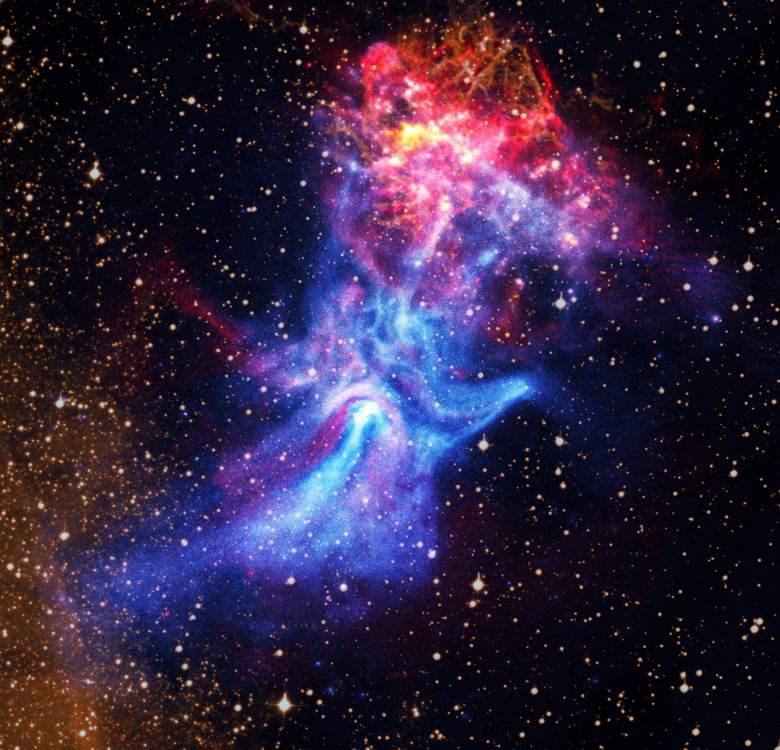
In an exciting collaboration among some of the most advanced telescopes, astronomers have captured a breathtaking image of the nebula MSH 15-52. This magnificent nebula is home to a pulsar, a dense remnant of a long-ago-supernova, spinning at incredible speeds. The unique blend of colors and shapes in this image evokes the image of a hand reaching out into the cosmos, a beautiful metaphor for the connection between the past and the present.
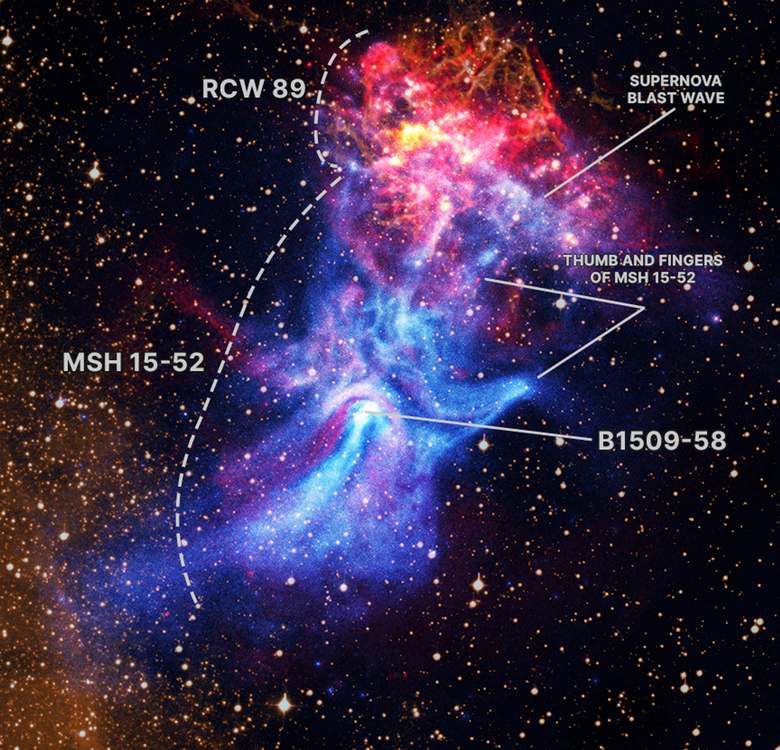
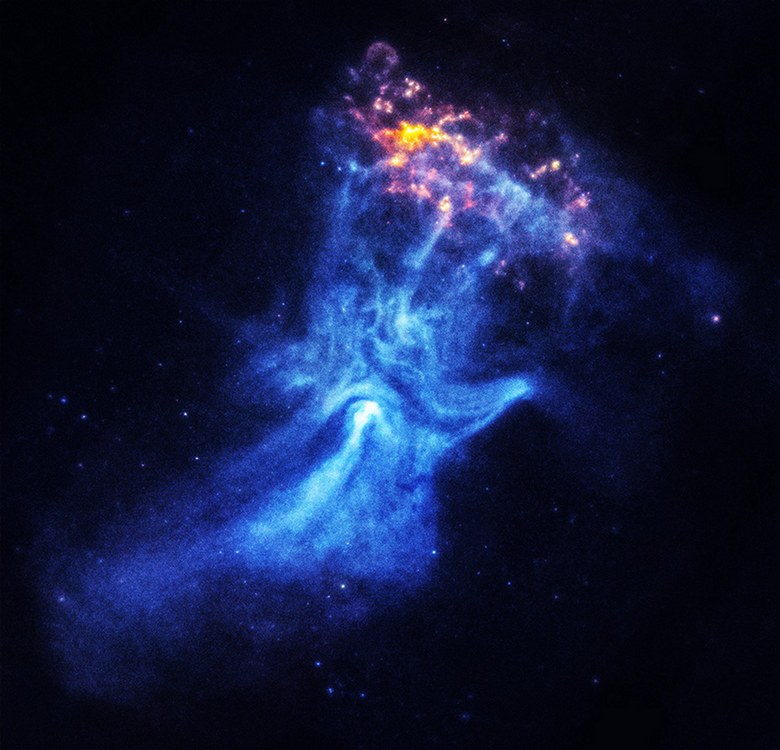
Back in 2009, NASA’s Chandra X-ray Space Observatory first unveiled the pulsar known as B1509-58, a tiny yet astonishing object located around 17,000 light-years away from us. Ever since that initial glimpse, astronomers have continually observed this object using various telescopes, piecing together the story it tells. Recently, new radio data from the Australia Telescope Compact Array has merged beautifully with Chandra’s X-ray insights, bringing fresh clarity to the cosmic tale written across the heavens.
This pulsar, sometimes referred to as a neutron star, is not just a solitary entity; it is the energetic heart behind the sprawling nebula that stretches over 150 light-years, an impressive distance equivalent to about 900 trillion miles! This incredible scale adds a sense of wonder as we ponder the vastness of our universe.
Yet, there remains much to unravel. Astronomers are particularly captivated by some intriguing features in the observations. One such mystery is the sharp edge of X-ray emissions that suggests a blast wave from the supernova. “It’s fascinating that young supernova remnants usually emit bright radio signals,” noted one of the researchers, expressing surprise at the absence of a radio signal at this boundary.
There’s so much left to explore! The exciting interplay between the pulsar and the remnants of the supernova keeps astronomers busy, as they gather more data and insights about these incredible phenomena. A fresh paper detailing this groundbreaking work, spearheaded by Shumeng Zhang from the University of Hong Kong, has recently been published in The Astrophysical Journal.
SHARE This Beautiful Image With Your Friends Who Love Space…
If you would like to see similar good news stories click here & Share this to brighten someone’s day.