

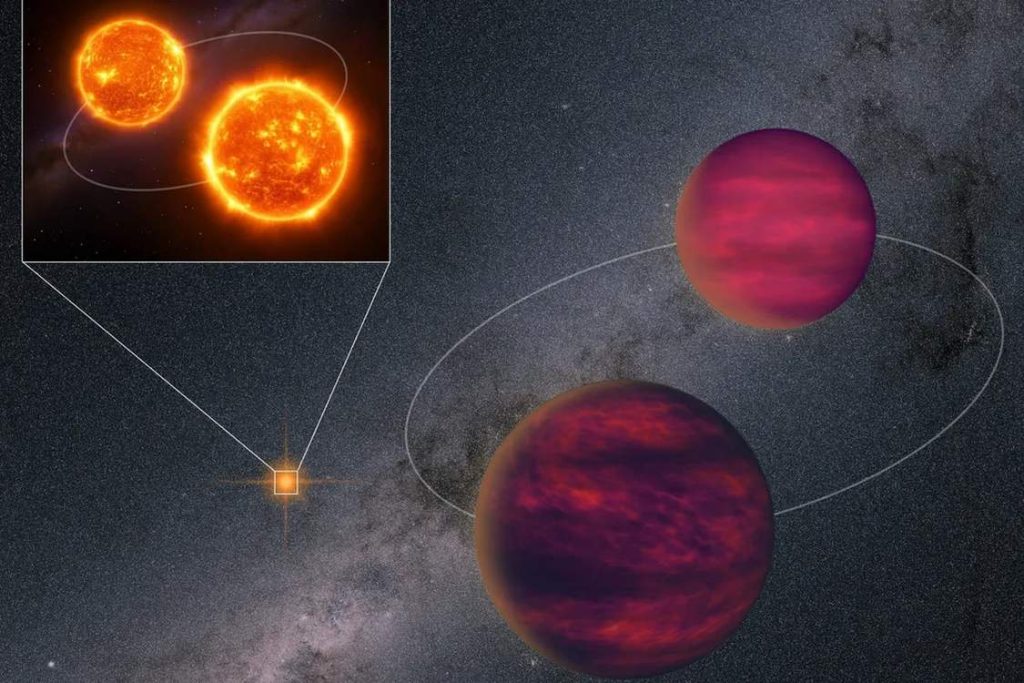
In a captivating revelation from the cosmos, scientists have uncovered a truly extraordinary star system that defies the boundaries of our understanding of stellar formations. Not only did they find a rare pair of brown dwarfs, but they also discovered these enigmatic objects orbiting two diminutive red stars. This remarkable discovery opens up new avenues for exploring our universe.
Recently, an international team of astronomers made waves in the scientific community with a discovery that could change how we think about the stars and planets. Nestled in the vast expanse of the Milky Way, they identified not one, but two brown dwarfs—a type of cosmic entity that lies somewhere between a star and a planet.
Brown dwarfs are fascinating because they lack the mass needed to sustain hydrogen fusion, the process that powers regular stars. Instead, they slowly cool and solidify over time, evolving to resemble planets more than stars. Their elusive nature makes them extremely hard to spot, even with advanced telescopes. So, you can imagine the excitement among the astronomers when they located not just one, but a pair of these cold entities, gracefully orbiting not one, but two red dwarf stars.
The discovery has been affectionately termed a “double-double” by one of the researchers, and it offers a unique opportunity for scientists to study these mysterious brown dwarfs in closer detail. Officially named UPM J1040−3551 AabBab, this fascinating system is located a staggering 1,656 astronomical units away from our Earth. What’s more, these brown dwarfs each have a mass that is between 9 to 28 times that of Jupiter, orbiting around their more familiar companions—the red dwarfs.
Red dwarfs are not only the smallest stars in our universe, but they are also incredibly common. Estimated to be between 300 million and 2 billion years old, these stars provide scientists with a rich canvas for studying the origins of light and the darker cosmic objects that accompany them.
As researchers pieced together the story of the brown dwarfs, they speculated that their formation might be tied to the material available in the system. Perhaps there wasn’t enough mass to create fully-fledged stars, leading the material to coalesce into these halfway beings instead. Simply put, there were too many stars vying for an insufficient supply of cosmic matter.
An article dating back to 2000 from NASA echoed similar narratives about brown dwarfs. At that time, the Hubble Space Telescope performed its largest inventory of these entities in the Milky Way, confirming that most brown dwarfs tend to be between 15 to 80 times the mass of Jupiter. However, the ones found in UPM J1040−3551 AabBab are notably smaller, reinforcing the idea of limited resources in this cosmic neighborhood.
This exciting discovery was made possible through the collaboration of several powerful astronomical tools, including the European Space Agency’s Gaia telescope and NASA’s Wide-field Infrared Survey Explorer (WISE), along with the Southern Astrophysical Research (SOAR) telescope based in Chile. The combined efforts of these instruments make this star system a thrilling arena for further exploration.
Adam Burgasser, an astrophysicist from the University of California San Diego and part of the research team, expressed his enthusiasm for the find. “This system offers a dual benefit for brown dwarf science,” he noted, highlighting how it can serve both as a calibration benchmark for studying low-temperature atmospheres and as a way to test evolutionary models, should they succeed in tracking the orbit of the brown dwarfs.
This discovery not only enriches our understanding of the cosmos, but it also provides a heartwarming reminder of the wonders that our universe holds just beyond our own little world. Share this extraordinary story with fellow space enthusiasts and keep dreaming of the stars!
If you would like to see similar good news stories click here & Share this to brighten someone’s day.