

In a remarkable scientific advancement, researchers have taken significant steps toward changing the landscape of breast cancer treatment. This story highlights the heartwarming journey of hope brought forth by innovative medical research, offering a lifeline to patients battling some of the most aggressive forms of cancer.
At King’s College London, a team of dedicated researchers has unveiled a groundbreaking antibody that targets treatment-resistant breast cancers. This isn’t just another drug; it represents a spark of hope for patients who have run out of options. The new antibody could be a game-changer for those suffering from especially perilous forms of the illness, including triple-negative breast cancer, which affects many younger women and people of color.
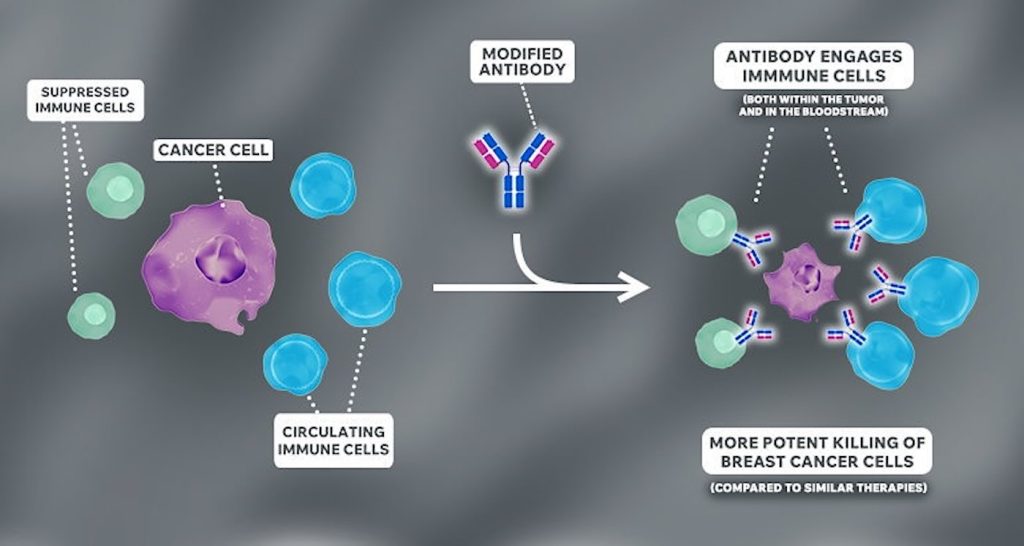
What sets this antibody apart is its unique design. Dubbed a “triple-engineered antibody,” it works on two fronts: it attacks cancer cells directly and simultaneously activates the body’s own immune defenses. Scientists believe this dual action could substantially enhance the effectiveness of treatments for patients whose cancers have become resistant to current therapies.
For over a decade, the Breast Cancer Now Research Unit has been at the forefront of innovations in this area. Their latest study, recently published in the journal Cancer Research, showcases how this newly engineered antibody has outperformed existing treatments in clinical experiments. In lab and animal studies, the antibody was shown to bind effectively to immune cells, invigorating them to launch a more robust attack against tumors.
Dr. Alicia Chenoweth, the study’s primary author, expressed her excitement: “By modifying the antibody’s structure, we developed a much stronger weapon against cancer than anything currently on the market. Many immune cells within the tumors are in a suppressed state, but our engineered antibodies can wake these cells up and spring them into action.”
Professor Sophia Karagiannis, who leads the research team, emphasized the importance of their work: “Our goal was to elevate how the immune cells interact with cancer cells, particularly in tumors resistant to other treatment forms. We’re pioneering a method that could redefine cancer therapy.”
With plans to advance to clinical trials, there’s an air of optimism surrounding this new approach. If successful, it could provide an urgently needed solution for the treatment-resistant cancers that have so long burdened patients and their families.
Current statistics reveal that triple-negative breast cancer accounts for about 15% of all breast cancer cases. Lacking key hormone and protein receptors found in other breast cancer types, this variant is notoriously challenging to treat. This reality makes the innovation from King’s College even more essential, as scientists are racing against time to create new and effective therapies.
Dr. Simon Vincent, the chief scientific officer at Breast Cancer Now, highlighted the critical need for this research, stating, “These women urgently require new treatment alternatives, especially given the higher chances of recurrence and the impact on younger populations.”
In an exciting twist, the potential of the new therapy may extend beyond breast cancer. The antibody could also target other cancers, such as ovarian and endometrial, showcasing its versatility and strength. The team’s next steps involve optimizing how long the antibody remains viable in the body and broadening the range of immune cells it can activate.
SPREAD THE HOPE: Share this inspiring news with friends and family, especially those who may find comfort in knowing that new treatments are on the horizon!
If you would like to see similar good news stories click here & Share this to brighten someone’s day.