

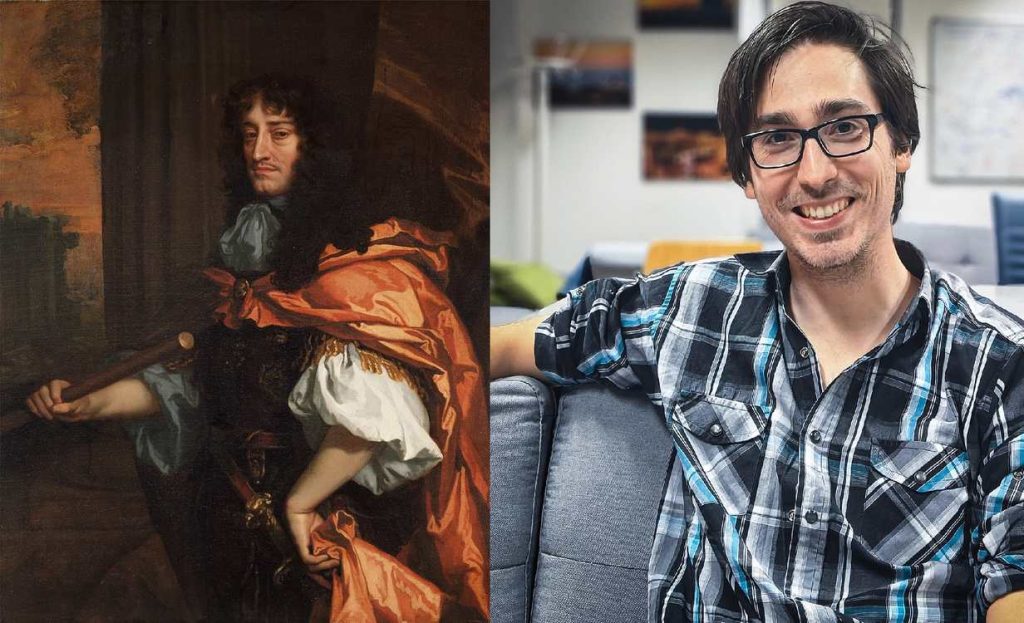
In a remarkable twist of fate, two mathematicians have resurrected a centuries-old debate, providing a heartening reminder of the joy and curiosity inherent in scientific discovery. Their journey not only shines a light on collaboration but also celebrates the beauty of problem-solving, all while paying homage to notable figures from history.
The story unfolds in the world of mathematics, where two childhood friends, Jakob Steininger and Sergey Yurkevich, embarked on a quest that began with a simple premise. They reminisced about a captivating phenomenon: envisioning a cube, tilting it just so, and watching as another cube passes effortlessly through it. This playful thought echoes a long-standing bet made 300 years ago between Prince Rupert of the Rhine and famed mathematician John Wallis. Rupert believed that with the right conditions, a cube could pass through another of the same size. He constructed a remarkable demonstration, a theorem that would later carry his name—the Rupert property.
Over the years, mathematicians explored all sorts of shapes, from tetrahedrons to dodecahedrons, confirming that these forms adhered to Rupert’s principle. The excitement within the mathematical community surged as they discovered highly complex shapes capable of slipping through one another in a seemingly magical fashion.
Fast forward to 2017, when a series of fresh studies enhanced our understanding even further. But this wonder led to an astonishing conundrum: was it possible to construct a shape that could not pass through itself? Enter Steininger and Yurkevich, who, inspired by a video of a cube-gliding miracle, dove headfirst into this intricate problem.
The duo relied on both creativity and rigorous logic, devising innovative theories that would guide their computer simulations. Their diligent work paid off, culminating in the creation of a whimsical 180-sided object they aptly named the “Noperthedron,” a playful nod to Rupert’s infamous property.
This unique shape brought an exhilarating sense of triumph, for it simply could not fit through itself, no matter how one manipulated it. After running 18 million simulations to ensure its validity, Steininger and Yurkevich confirmed a groundbreaking result in the realm of mathematics.
“We’re just humble mathematicians who love working on such problems,” Steininger shared, ever gracious in acknowledging their achievement. Their journey was not just about finding a solution to a historical conundrum, but also about nurturing their passion for mathematics and collaboration.
While they may have put a nail in Rupert’s age-old challenge, they keep their eyes peeled for the next puzzle to tackle. The spirit of inquiry and love for mathematics continues to thrive with these extraordinary individuals, reminding us all that even the most daunting challenges can lead to heartwarming discoveries and new beginnings.
Let’s celebrate these brilliant minds and their resolution to a quest that has spanned centuries!
If you would like to see similar good news stories click here & Share this to brighten someone’s day.